


Receiving It With Joy

When the newness wears off
Think back to something that was once new to you. A first job. A new home. A fresh start you were sure would change everything. At first we can hardly imagine growing tired of it.
Then the weeks pass. The excitement fades, and what once thrilled us now simply has to be carried. The same thing can happen with the Word of God. Many people hear the gospel with real gladness, and months later some of them are nowhere to be found.
Joy at the beginning is not the same as root.
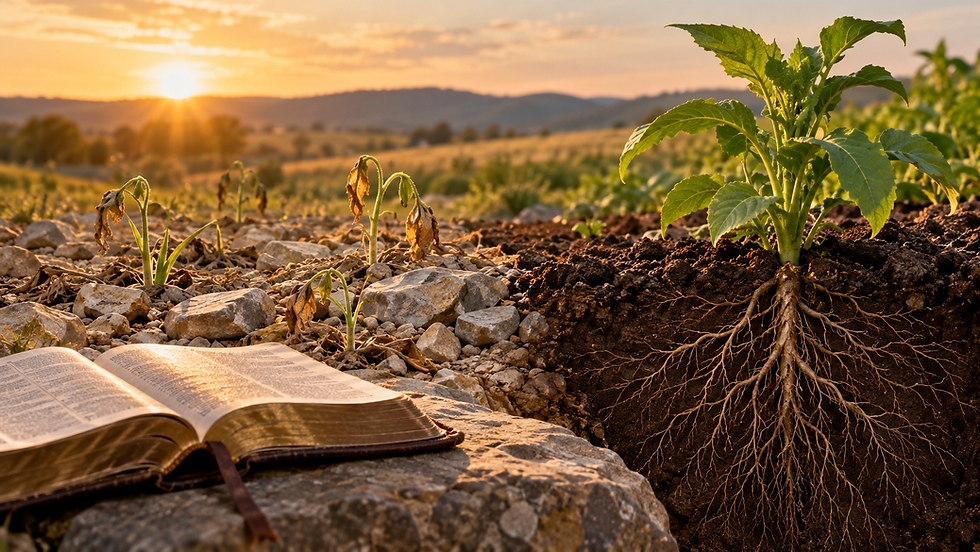
"But he that received the seed into stony places, the same is he that heareth the word, and anon with joy receiveth it; yet hath he not root in himself, but dureth for a while: for when tribulation or persecution ariseth because of the word, by and by he is offended." — Matthew 13:20-21
A seed that springs up fast
Scripture: Matthew 13:20-21.
Anyone who has planted a garden knows this. Some seeds come up almost overnight. A few days after planting, you see bright green shoots, and it feels like a great success.
Then comes the first hot week. The quick plants droop, turn brown, and die. The seeds that came up slowly are still standing. The fast ones never went deep. The Lord Jesus used exactly that picture to describe how people receive His Word.
The question that matters
The Bible is full of joy, and joy is good. But the question is not, "Did I feel something when I heard the gospel?" The question is, "Is my life rooted in Christ?"
That question matters for every hearer. A bright beginning can hide a shallow heart, and a quiet beginning can grow into a life of deep and lasting fruit.
Seed, heat, and roots
1. The seed and the soils show where the problem lies.
2. Joy without root withers when the heat comes.
3. A heart rooted in Christ stands and bears fruit.
The parable follows this order: the seed is sown, the heat comes, and the roots decide what remains. Each part helps us understand why the newness wears off for some and not for others.
As you read, consider your own heart. This is more than a study of a farming story. It is a question about what kind of ground the Word has found in you.
It begins with the seed
Before we look closely at the stony ground, we need to see the parable as a whole and hear how Jesus Himself explained it.
1. The seed and the soils
A parable Jesus explained
Scripture: Matthew 13:3-9, 18-23.
Jesus told of a sower who went out to sow. The same seed fell on four kinds of ground. Some fell by the wayside, and birds ate it. Some fell on stony places and sprang up quickly, but withered in the sun. Some fell among thorns and was choked. Some fell on good ground and brought forth fruit.
We do not have to guess what this means. Jesus explained it Himself. The seed is "the word of the kingdom." The ground is the human heart that hears it.
The seed is always good
The problem is never the seed. It is the same Word in every case. The difference is in the ground.
When someone falls away, we may be tempted to blame the preaching, the church, or the circumstances. Those things may matter. But Jesus places the main issue in the heart that receives the Word.
The Word of God does not change. Hearts receive it differently.
Four kinds of hearts
Scripture: Matthew 13:19-23 and Luke 8:12.
The wayside: hears but does not understand, and the devil takes the Word away before it can enter.
The stony ground: receives it immediately with joy, but has no root; it lasts for a while, then falls away when trouble comes.
The thorny ground: lets the cares of this world and the deceitfulness of riches choke the Word.
The good ground: hears, understands, and bears fruit, some a hundredfold, some sixty, some thirty.
The second soil describes so well what happens when the newness wears off.
Stony places
Scripture: Mark 4:5.
In Israel, much farmland lay over a shelf of limestone with only a thin layer of soil on top. Seed in that soil sprouted quickly, because the warm rock beneath heated the ground. But roots could not go down. When the sun rose high, the plant had no deep water to draw on.
The quick growth was not a sign of health. It was a sign of shallowness. Mark's account says it sprang up "because it had no depth of earth."
Quick growth on the surface can hide shallow ground underneath.
PAUSE AND REFLECT When the Word first reached you, what kind of ground did it find? |
Why does the quick plant die?
Shallow ground explains why the plant cannot last. Jesus also tells us what brings the heat that exposes it.
2. Joy without root
Joy is not the problem
Scripture: Acts 8:39 and Acts 16:34.
Jesus does not criticise this hearer for being joyful. The gospel is good news, and joy is a right response to it. The Ethiopian eunuch went on his way rejoicing. The jailer at Philippi rejoiced, believing in God with all his house.
The problem is not joy. The problem is joy with nothing underneath it. Jesus says this hearer "hath not root in himself."
Joy that rests on Christ lasts. Joy that rests only on feelings fades.
"Dureth for a while"
Scripture: Matthew 13:21.
This hearer is not pretending. He really is glad. He comes to church, sings, and perhaps tells others. Jesus says he endures "for a while."
That is why this soil is so sobering. In the early weeks, the stony ground can look exactly like the good ground. Both spring up. Only time and heat reveal the difference.
What brings the heat
Jesus names it: "when tribulation or persecution ariseth because of the word." The sun that withers the shallow plant is trouble that comes because of the Word. Today that heat may look like:
A family that mocks a new faith.
Friends who drift away because we no longer join them in sin.
Pressure at work or school to keep quiet about Christ.
The discovery that following Him costs time, money, and comfort.
Ordinary hardship, such as sickness, loss, and disappointment, which does not disappear after salvation.
"By and by he is offended," Jesus said. He stumbles over a cost he did not expect.
What the shallow heart received
Scripture: John 16:33.
Often the stony-ground hearer received a gospel that promised only good feelings. He liked the warmth, the fellowship, the music, and the new start. His faith rested on the feeling, not on Christ. When following Christ became hard, there was nothing deeper holding him.
This is a warning for all who share the gospel. Christ is not a quick fix that removes every trouble. Jesus said plainly, "In the world ye shall have tribulation: but be of good cheer; I have overcome the world."
Was he ever saved?
Scripture: Matthew 13:23; John 10:27-29; 1 John 2:19.
Jesus describes a plant that withers and bears no fruit. The good ground alone "beareth fruit." Scripture teaches that a person truly born again is kept by God and will never perish. It also teaches that some who seem to begin well "went out from us, but they were not of us."
The stony-ground hearer received the Word with emotion but never had the root of saving faith. That should not make true believers fearful. It should make all of us honest. Real faith rests on Christ, not on a feeling we once had, and real faith, however weak, has a root that God Himself keeps alive.
The heat does not create a shallow heart. It reveals one.
PAUSE AND REFLECT When hard times have come, has your faith drawn you closer to Christ, or further away? |
What makes the difference?
If the heat reveals shallow ground, what does a lasting heart look like? Jesus points us to the good ground and the roots that hold it.
3. A heart with deep roots
Rooted in Christ
Scripture: Colossians 2:6-7.
Paul writes, "As ye have therefore received Christ Jesus the Lord, so walk ye in him: rooted and built up in him, and stablished in the faith." The root of a lasting Christian life is not our feelings, our church, or our good start. It is Christ Himself.
A root does two things. It anchors the plant so storms cannot pull it out, and it draws up water so heat cannot dry it out. Christ does both for His people.
The deeper our roots go into Christ, the less the heat can wither us.
The tree by the rivers
Scripture: Psalm 1:1-3 and Jeremiah 17:7-8.
Psalm 1 and Jeremiah 17 both describe a tree planted by water. Jeremiah says this tree "shall not see when heat cometh, but her leaf shall be green; and shall not be careful in the year of drought."
The heat still comes. The drought still comes. The rooted tree is not spared from hard seasons. It simply has a source of life that hard seasons cannot reach.
The secret is given in both passages. The blessed man delights in the law of the LORD and meditates in it day and night. He trusts in the LORD, and his hope is the LORD.
How roots grow deep
Scripture: Luke 14:28; Matthew 6:6; Psalm 92:13; James 1:2-4.
Roots grow quietly and out of sight. No one sees them, but they decide whether the plant survives. God deepens our roots in hidden, ordinary ways:
Understanding the Word. The good-ground hearer "heareth the word, and understandeth it." Don't only feel the Word; study it.
Counting the cost as disciples. A believer who expects hardship is not surprised when it comes.
Praying in secret. The Father who sees in secret rewards openly.
Staying planted in a local church. "Those that be planted in the house of the LORD shall flourish."
Enduring the heat. Trials are not only tests; they are how God drives roots deeper.
Fruit in different amounts
Scripture: 1 Corinthians 3:6-7.
The good ground does not all produce the same harvest. Some bring forth a hundredfold, some sixty, some thirty. Jesus does not shame the thirtyfold believer. Fruit is the mark of life, and God gives the increase.
So the question is not whether my life looks as impressive as someone else's. The question is whether there is real fruit, coming from real root, over time.
Patient fruit over many years shows deeper life than a quick, bright start.
PAUSE AND REFLECT Which hidden habit would deepen your roots the most this week? |
Roots decide the end
We have followed the seed from the moment it lands, through the heat of trouble, to the harvest. The beginning looked the same for many hearers. The end shows what was underneath.
CONCLUSION AND APPLICATION
From seed to harvest
Let us walk back through the parable once. The sower scatters good seed. Some hearts never receive it. Some receive it with joy, but have no root, and wither when the heat comes. Some let the cares of this life choke it. And some receive it deeply and bear fruit.
The seed is good. The heat will come. Roots decide the end.
That truth concerns every one of us. Our beginnings were different, and our trials are different, but the same Word calls each of us to be rooted in Christ.
Key takeaways
Joy is a right response to the gospel, but joy is not the same as root.
Trouble does not create a shallow heart; it reveals one.
Lasting faith rests on Christ, not on a feeling we once had.
Roots grow in hidden places: the Word, prayer, the local church, and patient endurance.
The question is personal
Scripture: Matthew 13:9.
At the beginning we asked whether our lives are rooted in Christ. Jesus ended the parable with a call: "Who hath ears to hear, let him hear."
The most important question is not how I felt when I first heard the gospel. It is whether I have truly trusted Christ, and whether my life is drawing from Him today.
If you have not trusted Christ
Perhaps you remember a time you were stirred by the gospel. You felt joy. You may even have made a profession. But there has been no lasting root and no fruit, and when trouble came you drifted away.
Do not rest on that old feeling. Come to Christ now. Acknowledge that you are a sinner who cannot save yourself. Turn to God in repentance and trust Jesus Christ, who died for your sins and rose again. He promises, "him that cometh to me I will in no wise cast out."
You do not have to recover an old feeling before coming to Christ.
If you belong to Christ but feel dry
A dry season does not mean you have no root. Even rooted trees go through drought. Do not judge your salvation by your feelings. Rest on Christ's promise, and do what roots do: go deeper. Open the Word, pray in secret, stay planted among God's people, and let the heat drive you toward Him rather than away.
If you are helping new believers
Rejoice with them, but help them grow roots. Teach them the Word. Prepare them for trouble. Walk with them through their first hard seasons. A young plant needs care until it can stand.
An invitation to reach out
These truths invite each of us to look honestly at our own hearts. Is my faith resting on Christ, or on a feeling I once had?
If you have questions about the gospel, or would like someone to pray with you or study the Bible with you, we would be glad to hear from you. You are always welcome at Balkan Baptist Church in Novi Sad.
Do not measure faith by how fast it springs up, but by what it is rooted in.
Our prayer
Father, thank You for the good seed of Your Word. Plough up the hard and stony places in our hearts. Make us good ground that hears, understands, and bears fruit. When the heat comes, keep us rooted in Christ. Help us care for new believers, and give us patience to grow deep, not just fast. In Jesus' name, amen.
QUESTIONS ABOUT RECEIVING THE WORD
JOY, ROOTS, AND THE SOILS
1. Is it wrong to feel great joy when I first hear the gospel?
No. Joy is a right response to good news. The problem in the parable is joy without root, not joy itself. Healthy joy rests on Christ and grows deeper over time.
Scripture: Acts 8:39; Acts 16:34; Matthew 13:20-21.
2. Was the stony-ground hearer ever saved?
The plant withered and bore no fruit; only the good ground bears fruit. A truly born-again person is kept by God and will not perish. The stony-ground hearer received the Word with emotion but did not have the root of saving faith.
Scripture: Matthew 13:23; John 10:27-29; 1 John 2:19.
3. How is the stony ground different from the thorny ground?
The stony ground withers under heat: trouble and persecution. The thorny ground is choked by comfort: the cares of this world and the deceitfulness of riches. One falls through hardship, the other through ease.
Scripture: Matthew 13:20-22; Luke 8:14.
4. What does it mean to be "rooted" in Christ?
It means our life depends on Him. We trust Him, feed on His Word, and draw strength from Him. Roots are hidden, but they decide whether a plant survives the heat.
Scripture: Colossians 2:6-7; John 15:4-5; Ephesians 3:17.
TROUBLE, DRY SEASONS, AND FRUIT
5. Why does Jesus say trouble comes "because of the word"?
Following Christ brings opposition from the world and costs us things we once enjoyed. The gospel does not promise an easy life. It promises Christ's presence and final victory.
Scripture: John 15:18-20; John 16:33; 2 Timothy 3:12.
6. If I'm going through a dry season, does that mean I'm stony ground?
Not necessarily. Rooted trees also face drought. The difference is that the rooted tree keeps drawing life from its source. Look to Christ and His promise, not to how you feel today.
Scripture: Jeremiah 17:7-8; Psalm 42:5; 2 Corinthians 4:8-9.
7. Why do some believers bear more fruit than others?
Jesus says the good ground brings forth some a hundredfold, some sixty, some thirty. Fruit is the mark of life, and God gives the increase. Our responsibility is faithfulness, not comparison.
Scripture: Matthew 13:23; 1 Corinthians 3:6-8; John 15:8.
HELPING OTHERS GROW
8. How can we share the gospel without creating shallow converts?
Preach the whole gospel clearly: our sin, Christ's death and resurrection, and salvation by grace through faith in Him alone. Avoid promising that Christ removes all trouble. Then disciple new believers patiently and prepare them for the cost of following Christ.
Scripture: Luke 14:27-33; Acts 20:20-21; Acts 14:21-22.
9. How can we help a new believer grow roots?
Teach them the Word, pray with them, prepare them for opposition, and include them in the life of the church. Be present in their first hard seasons.
Scripture: Acts 14:22; 1 Thessalonians 2:7-12; 2 Timothy 2:2.
10. What is one root-deepening habit I can start this week?
Choose one: a daily time in the Word, a set time of private prayer, faithful attendance, or meeting with a mature believer. Small, hidden habits produce deep roots.
Scripture: Psalm 1:2-3; Matthew 6:6; Hebrews 10:24-25.
ABOUT THIS STUDY This study is part of our Wednesday evening series, When the Newness Wears Off. If it encouraged you, share it with someone who needs to hear it. |


Comments